
 +86 18721624519

Air-Cooled BESS Cabinet on Site: Environment Class, Clearance and Maintenance Checks Before You Install Outdoors
Two checkable facts decide whether an air-cooled C&I cabinet belongs on your site before anyone discusses cooling technology. One is the site's worst simultaneous combination of conditions. The other is the highest ambient temperature at which your chosen model can still deliver its rated output. Everything else — clearance, airflow, cleaning — follows from those two and from the model's own documentation rather than from a generic installation rule.
Start with one environment card, not four separate specifications
Site data tends to arrive in pieces: the facilities team has summer temperatures, the site survey notes coastal wind, the electrical contractor mentions dust from a nearby loading area, and the mechanical engineer has an altitude figure from a map. Each piece is usually checked against a different box, and the cabinet is chosen as if the site had one property. It almost never does. Air-cooled enclosures fail the site test where conditions coincide, not where any single value is extreme.
Build one card for the plot and read it as a combination. For an air-cooled C&I cabinet, record the daily maximum, the overnight low and the humidity around the cabinet rather than the regional average. Add the distance and direction to the sea or to another salt source, plus any visible particulate or fibrous material at the mounting position. Then note the altitude, and whether the cabinet would stand against a hot wall or under a canopy that traps air. Add the two entries that are easy to miss: whether these peaks occur in the same part of the year, and whether the cabinet sits on a shaded pad or in full sun.
Salt is the field most often reduced to a yes-or-no question. Wind-driven sea spray travels inland well beyond the beach frontage, so a site a few kilometres from the coast can still receive salt. An inland site next to a chemical process, an uncovered fertiliser store or a salt-treated haul road has its own corrosive source. Record the distance and the direction, then record what the exposure actually is: direct spray, mist, or deposited dust that only turns aggressive once it gets wet. Those are different conditions for a painted steel enclosure and for the components behind the door.
A concrete anchor makes the stacking effect visible. A factory in a hot region with a dusty yard and coastal proximity does not have three independent constraints. It has one operating environment in which the cabinet must reject heat into air that is already hot and humid, carrying abrasive particles, while its coating survives cycles of salt-laden moisture. Sizing that site on the coolest of the assumptions is the failure the card is meant to prevent.
Clearance and airflow follow from the model, not from a rule of thumb
An air-cooled cabinet rejects battery heat through its own enclosure surfaces and its internal air path to the outside air. That makes the immediate surroundings part of the thermal system. A wall a short distance behind a door-sized grille, a hot south-facing facade, a still corner behind a conveyor, or the exhaust of a neighbouring cabinet all raise the air temperature the cabinet has to work with.
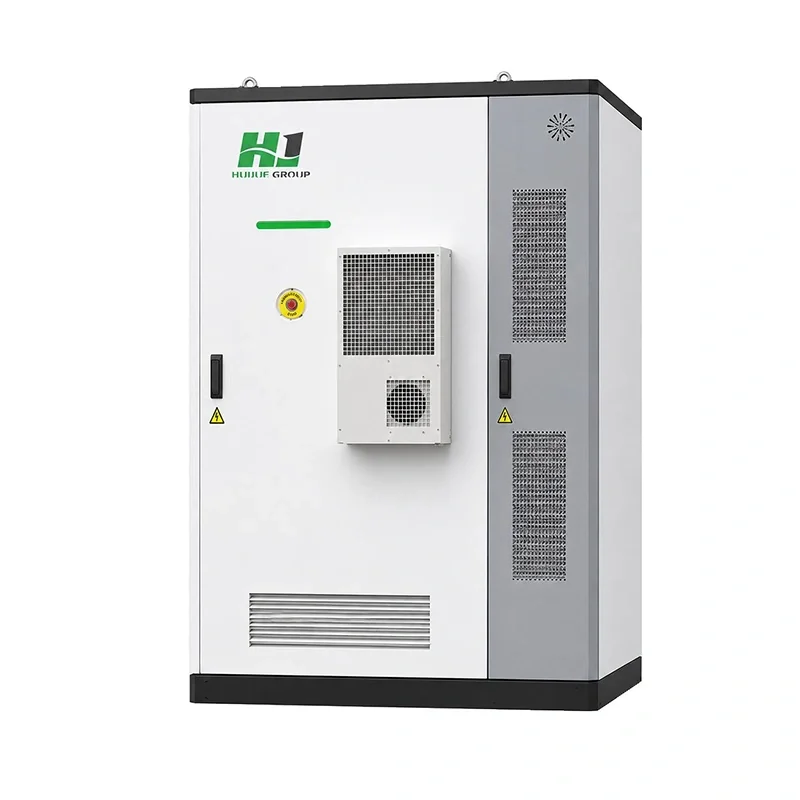
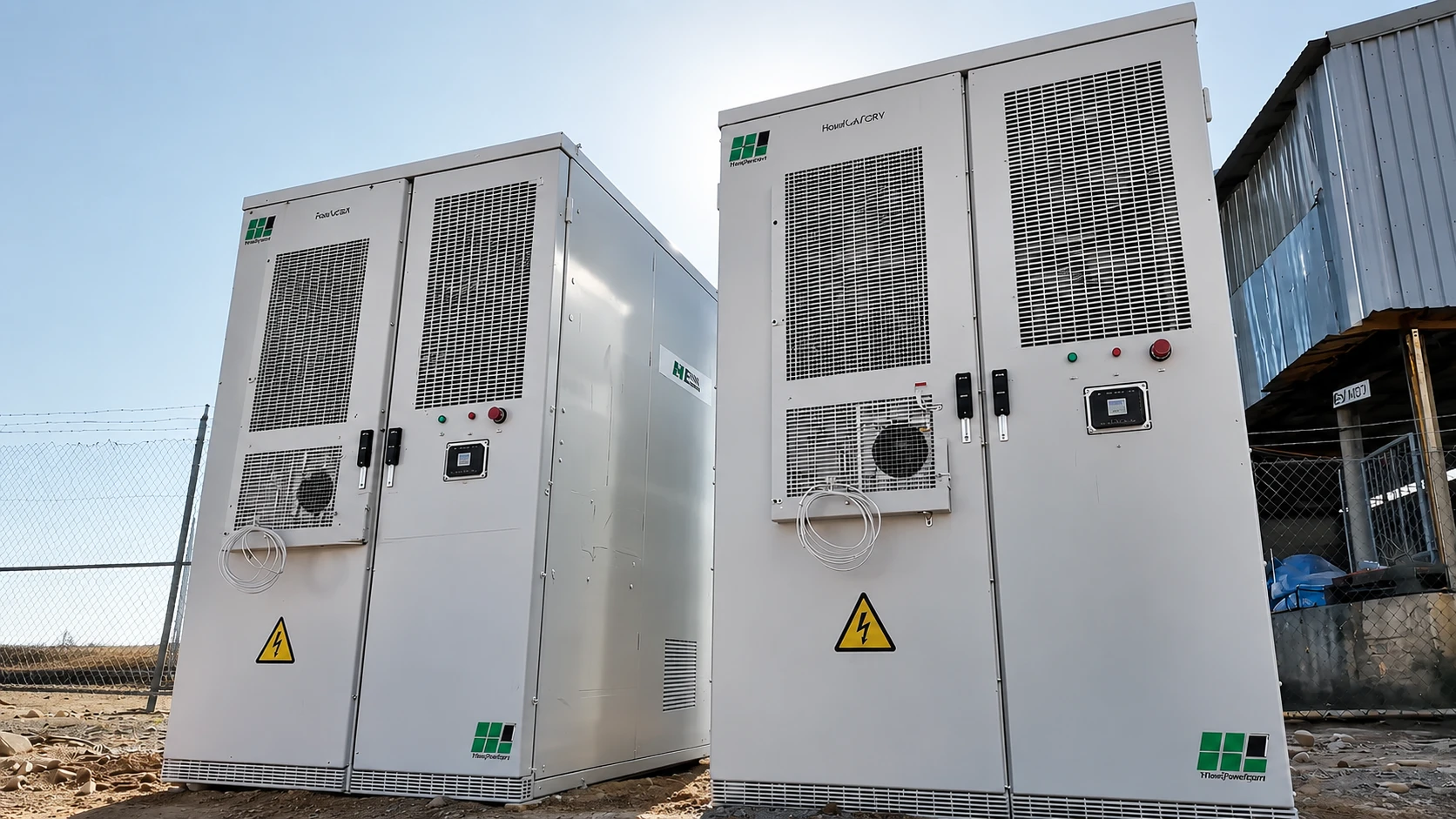
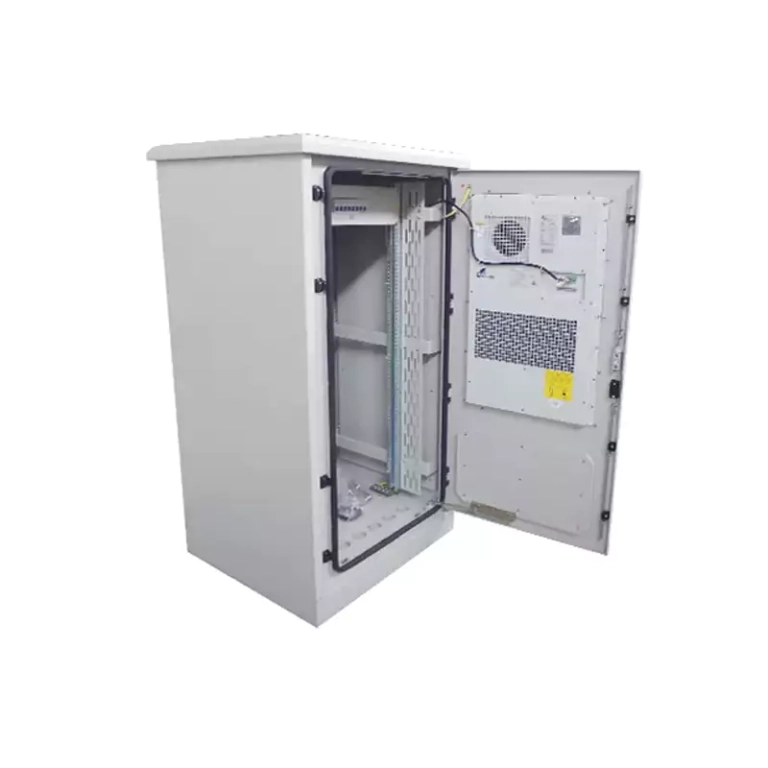
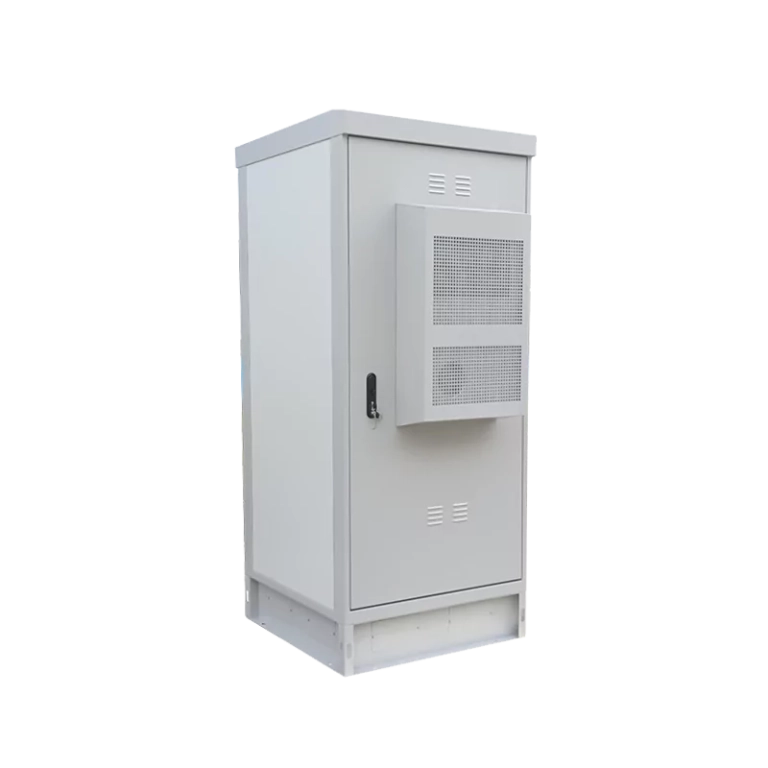
The cabinet in that photo wears its air path on the front: a louvred band along the bottom of the door, and a second set of tall louvred panels on the grey side section, split above and below a small round fan grille. Which faces admit air, which faces discharge it, and which are effectively sealed panels are properties of the specific cabinet. They are visible on a real product photo, on dimensional drawings and in the manufacturer's installation documentation. They do not transfer between models, even cabinets of similar capacity in the same product family. A specification quoting one clearance figure without saying which faces it applies to has told you almost nothing.
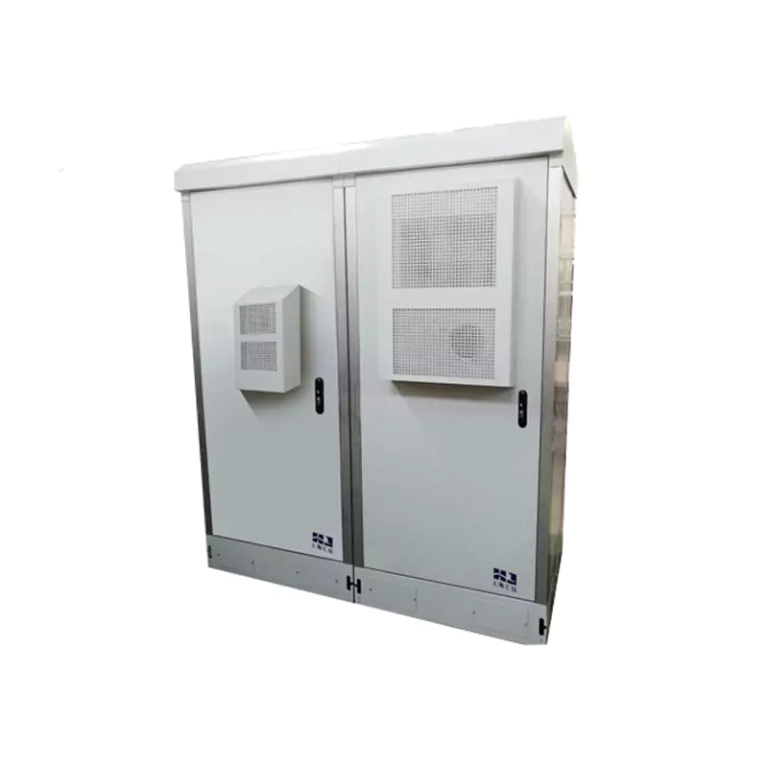
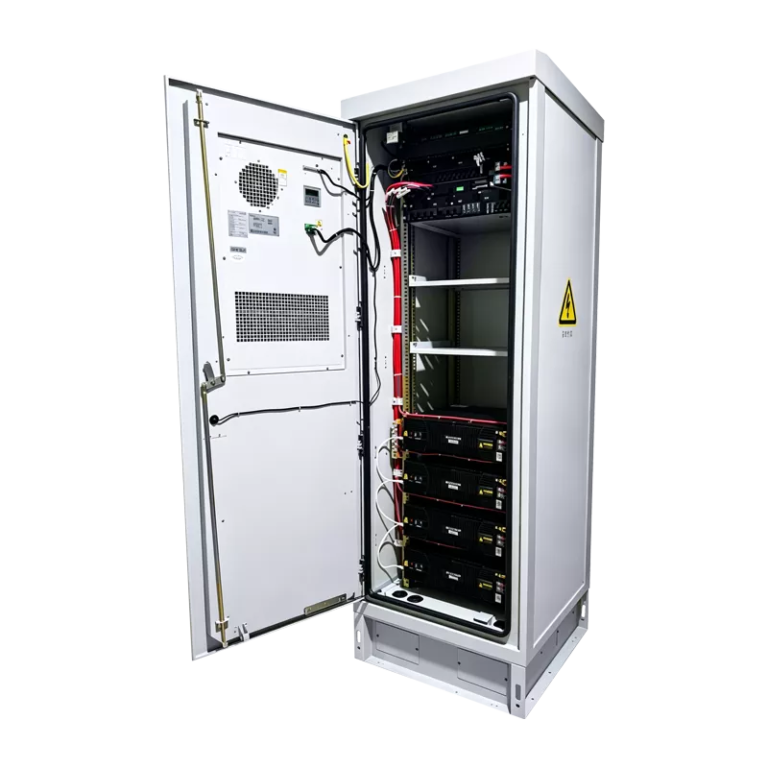
A second cabinet view, this time the 418 kWh outdoor cabinet, splits its front differently. The louvred band sits high on the left door, while the right door carries a display and status lamps, so one product family can put a large vent band at either end of the front depending on the unit. The configuration on your order is the one to measure, and the documentation for that configuration is the one to follow.
Parallel cabinets each need their own air, not one shared enclosure
The South Africa commercial and industrial project shows how quickly this becomes a layout problem. Two air-cooled cabinets, each rated 125kW/241kWh, operate in parallel at a combined 250 kW and 482 kWh, and the project page describes a modular architecture that can be expanded as load grows. Doubling the cabinet count doubles the heat to reject and the external surface to clean. If the second cabinet sits where the first one's exhaust arrives, each cabinet ends up cooling itself on the other's warmed air. Measured at the intake, the pair sees a higher ambient temperature than the site thermometer reports.
Treat each cabinet as having its own inlet-to-exhaust path, then place the array so those paths do not run into one another. In practice that usually means a single row with consistent spacing, and a service side that stays open when the array grows. A row wrapped around a second row, or an array enclosed by a screen wall on the exhaust side, recreates the hot-corner problem at larger scale. A short section line on your layout drawing that marks each cabinet's inlet and exhaust face, drawn before the placement is fixed, is worth more than any generic spacing number.
When expansion is part of the project story, as it is in the South Africa configuration, reserve the second and third positions with their own air paths and service frontage at the first design stage. The cost of that reservation is a few metres of site plan. The cost of discovering it after the concrete has cured is a cabinet that derates on the hottest day of the year.
Derating is a property of your model's table, not of the product class
The phrase “these cabinets run to 55 °C” travels easily and is rarely accurate when applied to a model. Temperature limits and derating thresholds differ across cabinet models, configurations and generations. The only defensible answer comes from the data table for the unit on your purchase order. A statement about the class, the family or a competitor's cabinet does not establish your model's operating envelope.
| Field on the parameter table | 241 kWh outdoor cabinet-type model HJ-G0110-0241F |
|---|---|
| Cooling method | Air-cooled |
| Rated power | 120 kW |
| Nominal capacity | 241.15 kWh (1P224S) |
| Working temperature | −25 °C to 60 °C, derated above 45 °C |
| Humidity | ≤95%, non-condensing |
| IP rating | IP54 |
| Altitude | 3,000 m, with derating above 3,000 m as published |
| Dimensions (W × D × H) | 1,400 × 1,300 × 2,387 mm |
| Weight | 3,000 kg |
Read the table in the order of your site card. A site whose daily maximum is 40 °C sits below that model's 45 °C derating threshold on the published row, so the threshold itself does not force a reduction. Whether the cabinet holds its rating at that temperature also depends on the enclosure and the air around it, which is what the clearance discussion is for. A site that sees 48 °C for several hours in August is inside the derated band, and the project's peak-shaving plan should use the reduced output rather than the nameplate figure. Two cabinet sizes on the same site can therefore give different answers, and the answer belongs to the model.
The temperature envelope is not the only row that matters. A cabinet installed at altitude loses cooling effectiveness as air density falls, and this manufacturer's 241 kWh table carries its own altitude row rather than a company-wide assumption. Moisture is specified as a non-condensing condition, which is a humidity boundary for this model's air path. In a coastal or monsoon climate, the site card should record whether condensation is likely at the cabinet surface during the daily temperature swing, because a non-condensing limit is a stated operating condition rather than a licence to operate in wet air.
Read the IP rating as an equipment classification, not as a synonym for weatherproof. IEC 60529 defines the two numerals of the IP code as a classification of degrees of protection provided by enclosures, so the code describes a tested protection condition rather than a general waterproof status. IP54 on this model is the rating the manufacturer publishes for the unit; it does not carry over to another configuration, and it says nothing about the coating on the steel.
Two routes on the same site, each with its own premise
The liquid-cooled project page and the air-cooled project page are worth reading together for what they say about site conditions, provided you keep the numbers with their own models. The Moldova commercial and industrial project uses 125kW/261kWh all-in-one liquid-cooled cabinets. Its key specification section lists IP65, an operating temperature of −30 °C to +50 °C, and RS485 plus Modbus TCP interfaces for that configuration. The liquid-cooled model page states IP55 for HJ-G0125-0261L, with its own temperature and altitude rows. Two published figures, two configurations, and no basis for swapping one for the other.
The Moldova page also records a site argument that belongs to that project. Limited civil-construction space created a need for factory-preassembled equipment and rapid installation, and the liquid-cooling system was chosen for its behaviour under the site's climate. The South Africa page describes the opposite premise: outdoor air-cooled cabinets on a site where the manufacturer names high-temperature and dusty conditions and describes a weather-resistant design with ventilation and temperature control. Neither page reports a measured result, and neither is evidence that one cooling method is superior in general.
Use the contrast to test your own site rather than to rank the technologies. If the governing constraint is the tightest possible footprint and a maintenance team that cannot keep an air path clear, the project shape resembles the Moldova case and the liquid-cooled cabinet is the configuration to discuss with your supplier. If the site can give each cabinet its own air and a service frontage, the air-cooled route resembles the South Africa arrangement, and the questions move to derating, cleaning and the model table. The criterion is which site premise you can actually maintain for the life of the project.
Maintenance access and cleaning decide whether the numbers hold
An air-cooled cabinet has a finite external heat-exchange surface, and every square metre of it collects what the site air carries. On the 241 kWh envelope, the two 1,300 mm deep side faces total roughly 6.2 m² of vertical surface, while the front and rear faces of about 1.4 m × 2.387 m add roughly 3.3 m² each. Dust, fibre and salt deposits sit between that surface and the air it is meant to reject heat into, so the thermal margin the table describes narrows between cleanings.
Plan the cleaning route at the layout stage. The cabinet needs a path to the surfaces that collect deposits, enough frontage to open the door and test the unit with instruments in hand, and a place to stand a ladder or platform that does not block the inlet while work is in progress. If the only route to the rear runs across a traffic aisle, or a fixed pipe rack sits between the cabinet and the maintenance position, cleaning becomes a shutdown event instead of routine housekeeping — and it will happen less often than the site card assumes.
Filters and accessible grilles need a removal and refit path, not only a cleaning schedule. Confirm from the documentation for your configuration whether the louvres or filter elements can be serviced from the front door, and whether rear access is required. Then check what the manufacturer specifies for cleaning media and intervals. The South Africa page describes the air-cooled architecture as eliminating cooling pipelines, coolant and pumps compared with liquid-cooling systems, which removes a class of circulating parts from the scope. That is not a claim of less maintenance overall: the external surface and the air path are now the equipment that needs attention.
The Moldova page offers a counterpoint on service geometry rather than a performance verdict. Factory pre-assembly there meant on-site work was limited to cable connections and commissioning, which moves the design effort onto the civil-construction footprint instead of door frontage. Different geometry, not a better or worse one. Whichever route you take, the maintenance question is whether your site can reach the parts that will need cleaning or testing across the whole service life, not only on handover day.
Hand the four fields to the supplier with the quotation
By this point the site discussion has produced four artefacts a supplier can price against, and none of them is a preference for a cooling type. The first is the environment card: daily maximum and overnight low, humidity at the cabinet, salt source and distance, particulate or fibre at the mounting position, altitude, and the peaks that coincide. The second is the layout drawing, with each cabinet's inlet and exhaust face marked, the array arrangement and the positions reserved for expansion. The third is the derating scenario: the site temperature profile read against the selected model's own table, using the reduced output wherever the site enters the derated band. The fourth is the access and cleaning plan: which surfaces are reachable, from where, how the door opens, and who cleans what and how often.
Send those four fields with the load, the backup duration and the grid conditions, and the quotation can state which model and configuration it prices, what that model's table says about temperature and altitude, and which installation conditions the design assumes. A quotation that arrives without those references has been priced against an average site, and your site is not the average.
We can review a site card and a layout against the air-cooled or liquid-cooled cabinet configuration it fits, and the starting point is those four fields rather than a choice between cooling methods.
Last Updated on 2026-11-20